What Is Slow Perfumery? A Guide to Niche and Artisan Fragrance
There is a moment in the life of every fragrance enthusiast when something shifts. A single smell - encountered on a stranger's skin, or drifting from an unfamiliar candle, or discovered in a small glass vial at the back of a boutique - stops them in their tracks. Not because it is the most pleasant thing they have ever encountered, but because it feels like something was made to be understood rather than merely worn. This is often a first encounter with slow perfumery.
Slow perfumery is not a marketing term. It is a practice, a philosophy, and increasingly, a movement - a response to decades of mass-market fragrance that prioritised familiarity and shelf appeal over depth, originality, and craft.
The Origins of Slow Perfumery
The phrase borrows deliberately from Slow Food, the Italian movement that emerged in the 1980s as a counter to the rise of fast food culture. Where fast food optimised for speed, cost and convenience, Slow Food argued for pleasure, seasonality, locality and the recovery of culinary traditions. Slow perfumery follows a similar logic.
For much of the twentieth century, the major fragrance houses operated within a commercial framework that prioritised mass appeal. Briefing notes for perfumers often specified scents that would test well across the widest demographic range, that would work in advertising, that would sell in volume. This produced perfume that was technically competent, often beautiful, but rarely surprising.
The slow perfumery movement emerged as a direct counterpoint. Beginning in the 1990s with houses like Serge Lutens and L'Artisan Parfumeur, and gathering force through the 2000s with the rise of independent perfumers and small-batch houses, it asked a different set of questions: What if fragrance was allowed to be strange, specific, difficult, or deeply personal? What if a perfume was designed not to appeal to everyone, but to mean something profound to someone?

What Defines Slow Perfumery?
Slow perfumery is not easily reduced to a checklist, but several defining characteristics recur across the most respected independent houses.
Intentional Ingredient Sourcing
Where mass-market fragrance relies heavily on synthetics - not inherently a problem, since some synthetics are beautiful - slow perfumery tends to engage more deeply with the provenance of its materials. This might mean sourcing genuine Grasse rose absolute, wild-harvested Australian sandalwood, or sustainably cultivated oud. The ingredient is understood as something with a story, a geography, a season.
A Longer Creative Process
Commercial fragrance development is typically measured in months and calibrated against focus group feedback. Slow perfumery operates differently. A perfume may gestate for years. The perfumer returns to a formula dozens of times, testing it across different seasons, on different skin types, in different concentrations. The result is a fragrance that has been truly considered.
Smaller Batch Production
Many slow perfumery houses produce in limited quantities, which serves both quality control and an honest relationship with demand. There is no pressure to scale a formula to an industrial vat - which sometimes means the fragrance behaves differently, better, on skin.
Design Integrity
Slow perfumery typically extends its philosophy into the physical object. Packaging tends toward restraint - clean lines, considered materials, minimal text. The bottle is designed to be kept. The box is designed to be reused or recycled.
Emotional Honesty
Perhaps most distinctively, slow perfumery tends to be emotionally honest. Rather than positioning a fragrance as aspirational lifestyle - wear this to be this kind of person - a slow perfumery house approaches its work as storytelling. A fragrance might be inspired by a specific place, a particular memory, a person, a moment in time.
The Rise of Niche Fragrance
Slow perfumery sits within the broader category of niche fragrance - a term that refers, somewhat loosely, to perfume produced outside the mainstream commercial model. Niche fragrance now represents one of the fastest-growing segments of the global fragrance market. Analysts estimate the sector will grow at a compound annual rate of over ten percent through the late 2020s, driven by consumers who are increasingly fragrance-literate and increasingly resistant to the homogenisation of mainstream offerings.
This shift is cultural as much as commercial. Younger consumers, in particular, approach fragrance with a collector's mentality: building wardrobes, reading formulas, seeking out discontinuations, and valuing the obscure.

LUMIRA and Slow Perfumery
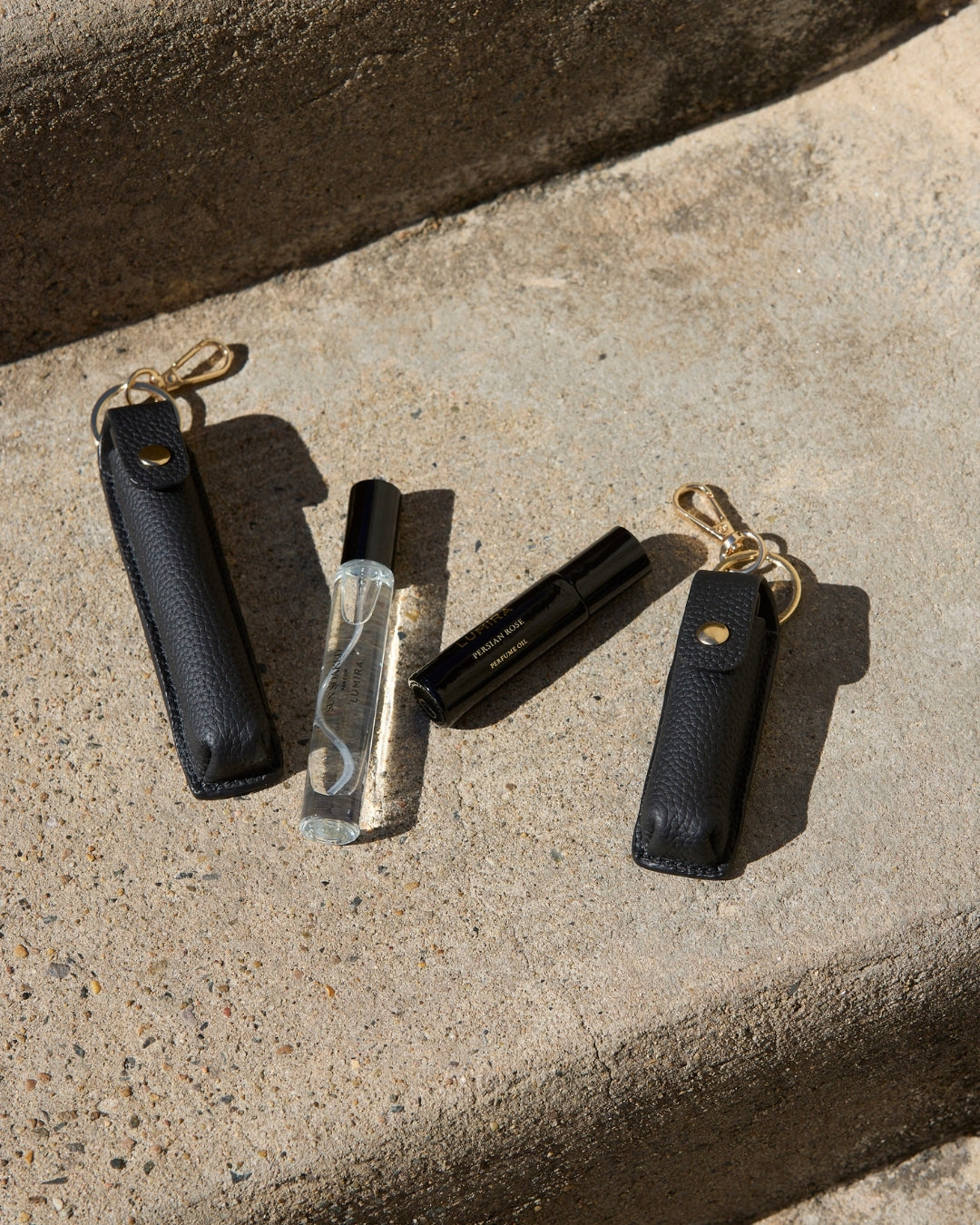
LUMIRA was founded in Australia as a slow perfumery house, though the phrase captures something the brand has always practised rather than a label it has sought.
Each fragrance begins as a journey: a place visited, an atmosphere absorbed, a particular quality of light in a particular season. Sun Soaked arrives at the coast of the Mediterranean in full summer, the mineral warmth of heated stone, the sweetness of fruit and salt air. Bois d'Epices moves through a northern forest in the depths of winter, where the spice routes end and the air carries a kind of learned warmth. Cuban Tobacco is an evening in Havana, the sweet, resinous curl of smoke after midnight.
LUMIRA is B Corp certified and handcrafted in Australia, which means each element of production - sourcing, formulation, manufacture - is held against values of craft and environmental responsibility. The fragrances are not made to disappear. They are made to stay.
Discovering Slow Perfumery
For those new to this world, a discovery set is often the most meaningful beginning. Rather than committing immediately to a full bottle, a collection of travel-sized vials allows time, the most important factor in any honest relationship with a fragrance. Wear each one across a full day. Return to the ones that continue to develop, that smell different in the evening than they did in the morning, that others comment on in the right kind of way.
The Future of Fragrance
The slow perfumery movement shows no sign of slowing. The growing sophistication of the fragrance-buying public, accelerated by the online communities and reference platforms that have emerged over the past decade, continues to raise expectations. Consumers know more about ingredients, formulation, and history than at any previous point. And that knowledge, once acquired, makes it very difficult to go back.
Slow perfumery is not a luxury in the sense of being reserved for a particular income bracket. It is a luxury in the original sense: the willingness to attend carefully to something, to take the time it deserves, to understand it rather than simply consume it.
Fragrance, at its most considered, is one of the oldest forms of human expression. Long before there were bottles or formulas, there was the instinct to gather resins, woods and petals and to coax meaning from them. Slow perfumery is, in the end, a return to that instinct. It asks not what a perfume should sell, but what it should say.